

Conveyor Belt Fastener
Why Choose Us
Shanxi Betop Industry and Trade Co., LTD. was founded in 2008, and honored as "Shanxi Provincial private science and technology enterprise", "Top 50 Taiyuan Manufacturing Enterprises". We specialize in producing T2 Cleaning Rubber C, T2 Solution B, T2 Solution A, T2 Compound B, Conveyor Belt Repair Patch, Conveyor Belt Cover Strip, Clean Solvent, Conveyor Belt Repair Glue, and other Conveyor Belt Cold Splice.
Advanced Equipment
Our company owns advanced testing instrument produced by Taiwan Gotech Testing Machines Co., Ltd. and Harbin Hapro Electrical Technology Co., Ltd.
Rich Experience
We expertise concentrate maintains for more than 15 years on fire retardant pulley lagging products specifically applied in large and underground coal mines. The products have been exported to more than 50 countries and regions all over the world.
Conveyor Belts One-stop solution
Our products include cold bond adhesives, quick repair glues, hot splicing joints tie gum, cover sheet, pulley lagging rubber sheets, sealing skirt board covering nearly all the materials necessary for conveyor belt reparation.
Quick Response
Our commitment is to respond to your inquiries within 24 hours, ensuring that you receive the information and support you require in a timely manner.
-
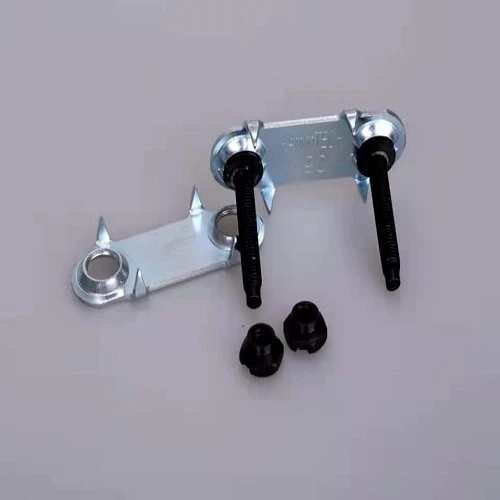
![Solid Plate Fastener]() Solid Plate FastenerSolid plate fastener,also called Conveyor belt fastener is a quick conveyor belt connection method, mechanical belt splice will help your conveyor belt running as soon as possible. There are many...read more
Solid Plate FastenerSolid plate fastener,also called Conveyor belt fastener is a quick conveyor belt connection method, mechanical belt splice will help your conveyor belt running as soon as possible. There are many...read more

Conveyor belt fasteners are manufactured in two styles—hinged and solid plate. Hinged belt fasteners are applied as individual segments to a belt end and then connected with a hinge pin. Solid plate fasteners span opposing belt ends that have been butted together, forming a tight, sift-free splice. If you want to know the specifications and prices of Conveyor Belt Fastener, please contact us!
Advantage of Conveyor Belt Fastener
Increased Efficiency
One of the primary advantages of fasteners is that they can help to increase efficiency in a variety of applications. Fasteners can be used to quickly and easily connect two or more components, which can save a significant amount of time and effort when compared to traditional methods such as welding or bolting.
Enhanced Safety
Another advantage of fasteners is that they can enhance safety in a variety of applications. For example, fasteners can be used to secure components in place so that they are less likely to become loose or detached, which could potentially lead to accidents.
Improved Aesthetics
In some applications, fasteners can also improve aesthetics. For example, hidden fasteners can be used to create a cleaner and more streamlined look in furniture or cabinetry.
Greater Strength and Durability
Fasteners are also typically stronger and more durable than traditional methods of joining two or more components. This is due to the fact that fasteners are designed to create a tight connection that is resistant to vibration and other forces that could potentially cause traditional methods, such as welding or bolting, to fail.
Reduced Cost
Fasteners can also help to reduce costs in a variety of applications. This is because fasteners are typically much less expensive than traditional methods such as welding or bolting. Additionally, fasteners often require less labor to install, which can further reduce costs.
Solid Plate Fasteners
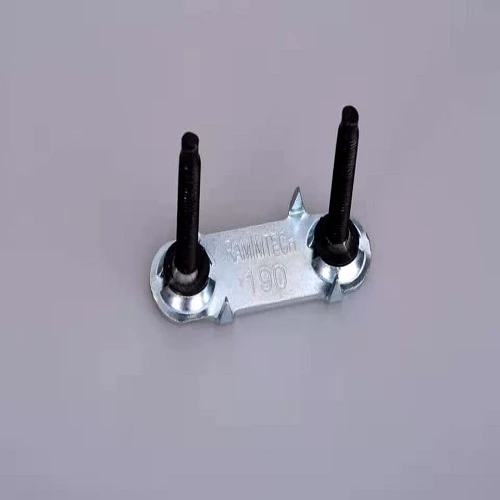
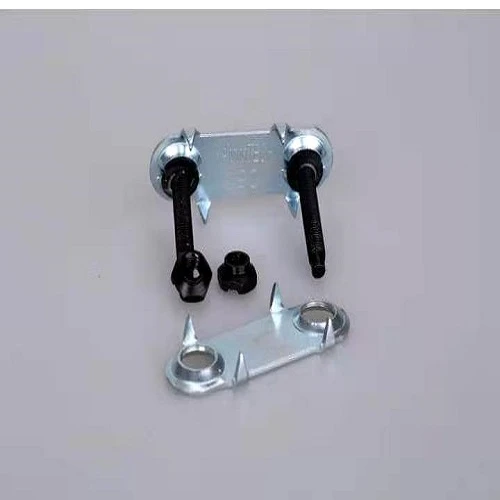
Solid plate are used where a sift-free splice is required (i.e. bulk conveying applications). The ends of the belt prevent fines from sifting through the spliced area, are considered as a permanent attachment, and are seldom used where the belt or the conveyor must be frequently disassembled. Solid plate fasteners also require larger minimum pulley diameters than hinged fasteners.
Hinged Fasteners
Hinged fasteners can be used on systems employing smaller pulley diameters. This design feature allows for a larger range of applications than is available with corresponding solid plate fasteners. Hinged fastener splices can be separated for belt removal or maintenance by removing the hinge pins. Some hinged fasteners have a sift-preventing component and can be used on belts conveying fines.
The hinge pin should be selected as carefully as the fastener itself. Select a pin of the same material as the fastener. (i.e. a stainless steel pin or a stainless steel fastener.)
Solid wire pins are the easiest to insert and are most often used on non-troughing applications. Stranded cable wire pins are recommended for troughing conveyors given their greater flexibility.
Both solid wire pins and stranded cable pins are offered either with or without an external polymer covering. This polymer "jacket" serves as a lubricant when positioned between the loops of the hinged fasteners. As such, this pin style is less likely to wear or corrode. However, they are not the preferred choice where fine abrasive materials are being conveyed, wherein a solid wire or unjacketed cable pin is a better selection.
Other hinge pin choices include nonmetallic pins for smooth running at lower belt operating tensions as well as notched or corrugated pins which reduce the likelihood of pin migration.
Hinge pin selection is as important as proper hinged fastener selection. Properly selected and installed, they contribute to maximum splice life and performance. As with selecting hinged fasteners, the fastener manufacturers should be consulted for hinge pin recommendations.
Light and Heavy Duty Options
Light-duty conveyor belts generally have a tension rating of 160 PIW or less, while heavy-duty conveyor belts have tension ratings exceeding 160 PIW. Light-duty conveyor belt fasteners include wire hooks, common bar lacing, stapled plate fasteners, plastic hinged plate fasteners, and plastic spiral loop fasteners. Heavy-duty conveyor belt fasteners include bolted and riveted plate fasteners and stapled, bolted, and riveted hinge fasteners. Heavy-duty fasteners are available for operating tensions up to 1500 PIW.
Eliminate Belt Fastener Failures
It's also fairly simple to analyze your belt to determine if there is a mechanical lacing that will extend your belt life. A minor tweak such as changing the grade of metal, type of pin, or profile of the lace can dramatically increase belt life on the same material.
Types of Conveyor Belt Fastener
Hinged Fasteners
In hinged-fasteners splices, a strip composed of top and bottom plates joined on one side by metal loops is placed on each of the two belt ends. These strips are attached to the belt by staples, bolts or rivets. The belt is then joined by passing a linking pin through the alternating hinge loops.
Hinged fasteners are usually supplied in continuous strips to fit standard belt widths. These strip assemblies ensure proper spacing and alignment. The strips are fabricated so pieces can be snapped off to fit non-standard belt widths.
The chief advantage of hinged fasteners is that the belt can be separated by removing the linking pin. This way the belt can be shortened, extended, removed from the structure, or opened to allow maintenance on conveyor components.
Hinged fasteners provide several other benefits. Installation on the two belt ends can be done separately and even preformed off-site. While it is not a recommended practice to join belts of different thicknesses – because of problems it can create, including sealing, tracking, and cleaning – hinged loop fasteners would allow different thicknesses of belting to be combined using fasteners matched to their respective belt halves.
Solid-Plate Segments
A second type of mechanical splice is performed with plate fasteners. This class of fastener makes a strong, durable joint with no hinge gap for fines. Plate fasteners are effective in the most rugged conveying applications in mines, quarries, and steel mills. In applications where the belt is thicker than 22 millimeters (7/8-in), plate fasteners are the only choice for mechanical fastening.
Solid-plate segment fasteners are intended for permanent joints only and are not recommended for belts in applications that require opening of the joint to change belt length or location. Solid-plate segment fasteners are typically provided as individual pieces packed loose in a box or bucket. The plate segments are installed from one belt edge to the other using stables, rivets, or bolts.
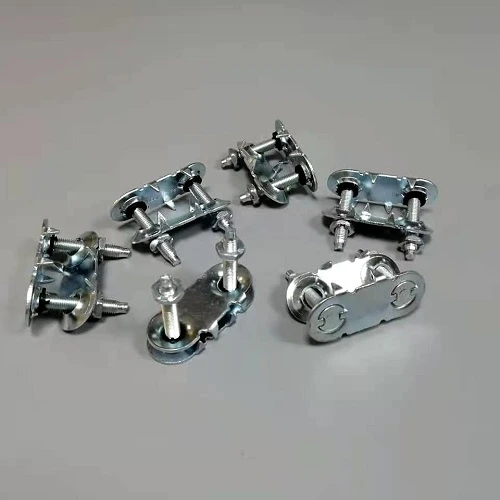
Bolted solid-plate fasteners have some unique advantages. They can be applied diagonally across the belt to allow use on pulleys that are smaller than the size recommended for the fastener. They can also be installed in a V-shaped pattern, which may be the only choice for using fasteners to join thick, high-tension belts designed for vulcanization.
One problem with bolt-fastened solid-plate segment fasteners is that they typically use only two bolts on each plate, with one on each side of the splice. Tightening down on the end of the splice means the leading and trailing edges are more compressed than the middle of the plate. This allows the middle to crown, creating a wear point in the fastener and in belt cleaners or other systems that contact the belt as it moves on its path through the conveyor.
Riveted solid-plate fasteners are designed for the most demanding, highest-tension applications. The multi-point attachment on each side of the hinge provides the highest holding power of any mechanical fastener. They can be installed without power tools, using a hammer to set the rivets and break off any heads above the belt. This is an advantage in remote or underground locations.
Clipper Wire Hook
Clipper wire fasteners offer one of the cheapest and easiest-to-install fastener options. These wire hooks work similarly to staples and binder rings. Each end of the fastener's hooks fits inside the holes of the belt seams. They clip onto both sides of the opposite belt, looping the two belt ends together. Like hinged fasteners, they provide flexibility to the belt joints. Note that they provide the most benefits to wide belts compatible with lacing similar materials.
Alligator Lacing
Alligator lacing fasteners work similarly to clipper wire hooks, but they provide more structure, less bend flexibility, and a zipper-like fitting. Unlike the other fasteners, they come as one piece that runs along the edge of the belt ends instead of tiny, separate attachments. Installing alligator lacing takes very little effort. The process requires a hammer, and can be done by hand. Alligator lacing works with various belt widths and provides uniform tensioning.
Different Type of Fastener Installation Procedure
Bolt Solid Plate
This kind of conveyor belt fasteners are easy to install on-site using templates, punches and boring tools: first place the template in place. Then, spray lubricant through the template holes and drill or drill holes at both ends of the belt. Insert the bolt into one end of the belt. Fold one end of the belt back and insert the bolt into the other end.
Align the bolt with the template teeth and place the other end of the belt on the bolt. After removing the template, insert the top plate and threaded nuts into the bolts. The woven tape passes through the board and is tightened as you tighten the board (tighten the two outer boards, first keep the tape in place). Tighten the nut; hit the plate with a hammer. Break the ends of the bolts and grind them flat.
Bolt Hinge
Align the template with the end of the belt and nail it into the center arrow away from the belt. Spray holes with silicone lubricant and punch holes in the belt. Place the fastener on the belt with the hinge facing up. Insert the bolt and tighten the nut by hand to engage the lug on the fastener. From the outside to the inside, use a wrench to fully tighten the nut to ensure that the fastening teeth penetrate the bottom surface of the belt. Insert the gauge pin into the fastening ring; unscrew the bolt and grind it flat. Insert the filling tube with the gauge pin as the guide. Once in place, remove the gauge pin. Repeat the above steps on the other end and connect the two ends together. Insert the gauge pins into the two sets of fixing rings. Insert the hinge pin from the opposite end and pour out the gauge pin as you go. Place a washer on the hinge pin and secure it in place.
Rivet Articulation
Use tool to firmly fix the belt, fasteners and guide block in place. Insert up to 8 rivets at a time. The tool aligns belts, hinges and guides to ensure perfect lace.
Alligator Stapler
Align the conveyor belt fastener to the belt, use the alligator preparation tool to lock it in place. Open the staples. The tool inserts two nails at the same time and can then easily move along the belt to drive the next pair.
Scissors Wire Hook
Once the belt are ready for use, guide the belt through the clamp and over the belt support frame, and then lock the belt clamp. Rotate the adjustment head counterclockwise until the roller touches the hook after placing the roller on the hook. Return the lace head to the end of the lace and turn the knob one and a half rotations (counterclockwise). Then, using a drill bit or manual override, drive the broach head across the width of the belt at a low to medium speed. Turn the adjusting knob counterclockwise half a turn, and repeat this operation until the hook is embedded in the belt that is 1/3 to 1/2 of the diameter of the wire. Finally, remove the lace needle, loosen the belt clamp, and remove the belt from the lace.
Alligator Lacing
Install this one-piece fastener strip using only a hammer. The lacing is held tightly in place by clips and a gauge rod as the teeth bite into the belt to complete the splice.
Plastic Rivet and Plastic Spiral Lace
Installations of these non-metallic fasteners should be performed by professionals with extensive training and experience. Accurate Industrial's belt technicians will install these fasteners to ensure the highest possible quality and lace life.
Certifications

Our Factory


Frequently Asked Questions
We're well-known as one of the leading conveyor belt fastener manufacturers and suppliers in China. Please feel free to wholesale high quality conveyor belt fastener at competitive price from our factory. Contact us for more details.
, primer for metal surface